
EpoCanvas Mail Project Overview
Effective Date: October 1, 2026 | Version: 5.5
EpoCanvas Mail represents a paradigm shift in digital communication, engineered as a rigorously secure, strictly non-commercial, and community-driven open-source platform. At its core, the project embodies the philosophy of “Dual-Nature Fusion,” bridging the gap between a seamless, globally distributed managed service (mail.epocanvas.com) and a completely sovereign, self-hostable ecosystem (epocanvas-mail). Released under the MIT License, our mission is to provide an uncompromisingly private mailbox solution that relies on modern edge architecture rather than legacy centralized servers, completely eliminating data monetization and opaque telemetry.
[!IMPORTANT] The Dual-Nature Ecosystem: EpoCanvas Mail is not a traditional SaaS product. It is a dual-nature platform. The managed service provides a zero-friction entry point for users seeking secure communications without administrative overhead. Conversely, the open-source release empowers developers and privacy advocates to deploy the exact same robust infrastructure within their own Cloudflare environments, assuming total control over their data routing, storage, and security policies as independent Data Controllers.
Open-Source Autonomy and MIT Licensing
The entire foundation of EpoCanvas Mail is built upon open-source principles. Distributed under the permissive MIT License, the source code is freely available for inspection, modification, and redistribution. This transparency is the bedrock of our security model, allowing independent researchers to audit the cryptographic implementations and architectural boundaries. While the license grants immense freedom to self-host and customize the software, it also establishes clear boundaries regarding brand protection: third-party deployments are strictly prohibited from masquerading as the official EpoCanvas Mail managed service to deceive users or bypass anti-spam protocols.
Edge-Native Technical Architecture
EpoCanvas Mail discards legacy server architectures in favor of an entirely edge-native design. By deeply integrating with Cloudflare Workers, the application logic is distributed globally across hundreds of data centers, executing within milliseconds of the end-user. This Anycast routing ensures unparalleled low latency and high availability. State and persistent data are securely managed via Cloudflare D1 (relational database) and KV/R2 (object storage), ensuring that computing resources remain stateless and ephemeral. This architecture not only scales effortlessly but also fundamentally reduces the attack surface by eliminating persistent, exploitable backend servers.
Uncompromising Security Design
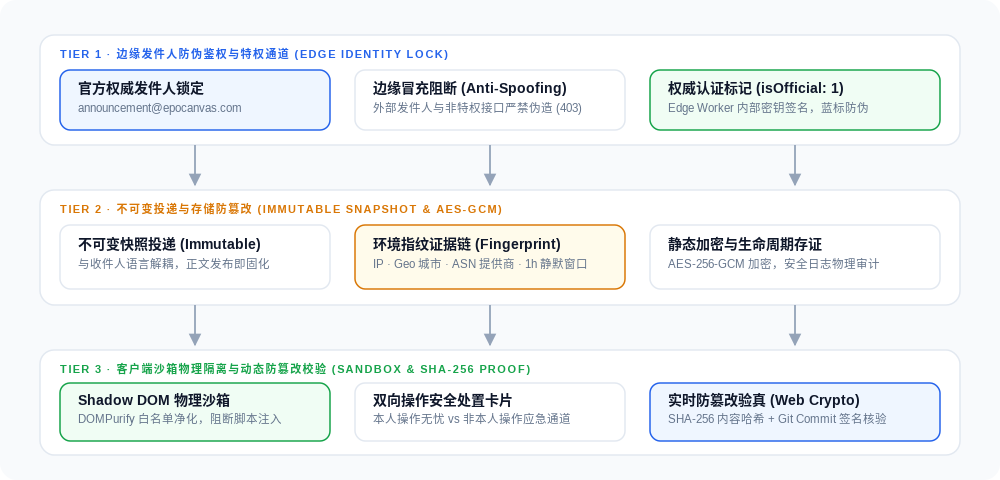
Security in EpoCanvas Mail is not an afterthought; it is the structural framework of the project. The platform mandates AES-256-GCM encryption for all data at rest and TLS 1.3 for all network transport. We have completely eradicated legacy passwords in favor of phishing-resistant WebAuthn and Passkey authentication, ensuring that user credentials remain securely bound to local hardware enclaves. Furthermore, the system architecture operates under a strict “Zero Telemetry” mandate—no behavioral data, analytics, or diagnostic logs are ever transmitted to EpoCanvas developers, guaranteeing absolute privacy for both managed and self-hosted users.
[!TIP] Getting Started with Self-Hosting: With just one domain and a free-tier Cloudflare account, administrators can deploy a fully functional instance of EpoCanvas Mail in minutes. Review the deployment guides to learn how to initialize your secure edge infrastructure.
Development History and Verifiable Commit Chain
Since its inception on July 21, 2026, EpoCanvas Mail has maintained a meticulous, verifiable development history. Every architectural decision, security patch, and feature addition is documented within a transparent commit chain. This verifiable history is essential for establishing trust, allowing instance operators to trace the evolution of the software and independently verify the integrity of the codebase before deploying updates to their self-hosted environments. We remain committed to open governance and continuous security iteration driven by community feedback.